Tuesday, October 18, 2011

Eradicating Malaria - BBC News

Good news for Africa!
Especially since Malaria is a frequent and expensive problem for our students, staff and friends in the community...

http://www.bbc.co.uk/news/health-15346624


18 October 2011 Last updated at 07:46


Malaria deaths fall nearly 40% worldwide in last decade


There has been a fall of nearly 40% in the number of deaths from malaria worldwide in the past decade, the World Health Organization says.
A new report said that one-third of the 108 countries where malaria was endemic were on course to eradicate the disease within 10 years.
Malaria accounts for 20% of childhood deaths in Africa.
Experts said if targets continued to be met, a further three million lives could be saved by 2015.
Malaria has been eradicated from three more countries since 2007.
The Roll Back Malaria Partnership aims to eliminate malaria in another eight to 10 countries by the end of 2015, including the entire WHO European Region.
The mosquito-borne disease is most prevalent in sub-Saharan Africa, where 85% of deaths occur. In 2009, 781,000 people died from malaria.
Robert Newman, director of the WHO's Global Malaria Programme, said "remarkable progress" had been made.
"Better diagnostic testing and surveillance has provided a clearer picture of where we are on the ground - and has shown that there are countries eliminating malaria in all endemic regions of the world," he told an international Malaria Forum conference in Seattle.
"We know that we can save lives with today's tools."
Global eradication
A global malaria eradication campaign, launched by WHO in 1955, succeeded in eliminating the disease in 16 countries and territories.
But after less than two decades, the WHO decided to concentrate instead on the less ambitious goal of malaria control.
However, another eight nations were declared malaria-free up until 1987, when certification was abandoned for 20 years.
In recent years, interest in malaria eradication as a long-term goal has re-emerged.
The WHO estimates that malaria causes significant economic losses, and can decrease gross domestic product (GDP) by as much as 1.3% in countries with high levels of transmission.
In the worst-affected countries, the disease accounts for: up to 40% of public health expenditures; 30% to 50% of inpatient hospital admissions; and up to 60% of outpatient health clinic visits.

Monday, October 17, 2011

Concert in Butembo

We took a trip to Butembo yesterday (spending just a few hours there), to support our church's choir, Echo du Salut. They sang with another choir from Goma and Orioni, a Butembo choir in a large concert. Here are a few images! 

singers from Goma

 some of the musicians

 Echo du Salut

 Zack and Kizito leading the song

some of the ladies

Orioni choir from Butembo

And now I need a massage... It's been a long time since I've made that trip to Butembo - twice in one day! It's physically exhausting. And unfortunately, I don't have photos of all the dust I had to wash off of me after getting home... That might be kind of gross though! 

But thankfully, we had no car or any other troubles. Besides, smooth travel wasn't really expected and it's not the reason we went to Butembo. It was to support and be a part of our local choir. 

The day and the concert, were both beautiful. 

Friday, October 14, 2011

Recently...

our house

Becoming pros - Noé and Tikva making samosas!


Bye Tikva :(


My new boss, Joel


UCBC students with Sabato (holding the flowers), 
after he gave his final presentation for graduation


Noé crossing a small river

Eating grilled meat on the road with Baraka 

Wednesday, October 12, 2011

Silence is "not" golden...

This is an interesting opinion piece on Huffington Post
http://www.huffingtonpost.com/rev-otis-moss-iii/congo-breaking-the-silenc_b_1003431.html

I love when I find articles about Congo... Most aren't good or positive, but hearing and knowing people are talking (even if just a little) about this country, is so important!


Silence Is 'Not' Golden When It Comes To The Congo


Rev. Otis Moss III
Senior Pastor, Trinity United Church of Christ in Chicago


The ancient proverbial statement says, "Silence is golden." But how can a person, especially a person of faith, be silent when a woman is raped every minute and 45,000 children, women and men are dying in the Democratic Republic of Congo?

The Democratic Republic of Congo is the one of the most mineral-rich countries in the world. 64 percent of the world's reserve of Coltan, the mineral that allows you to read this on your iPad, laptop, desktop computer or cell phone -- comes from the Democratic Republic of Congo. The commercial sale of cell phones and computers is a $1 billion dollar per year global industry. But 80 percent of Congolese women, men and children live on 30 cents or less per day. At the July 2011 "Voices from the Congo" Conference at the U.S. Holocaust Memorial Museum, U.S. Senator Dick Durbin (D-IL) , who has traveled to the Congo twice said, "It is a nation of breathtaking natural beauty, rich in natural resources. It is also a badly broken country dominated by relentless poverty, war lords, pillaging soldiers, and horrific, almost incomprehensible violence."

The national and global politics of Blood Coltan mining includes the minute-by-minute rape of women and the deaths of children every day. The six million deaths caused by Blood Coltan mining exceeds the number of people who have died around the world in any war in the history of humanity. Why is the world silent? Why is the Christian community silent? Why is the interfaith community silent about this indescribable human tragedy?

Like the Bible, each religion's source of truth emphasizes that love, righteousness and justice are guiding principles for human beings. Yet, silence is offered instead of an interfaith clarion call for justice on behalf of our beloved Congolese sisters and brothers. Are we not our brothers' and sisters' keepers?

We must break the silence about the daily child deaths, rape of women and economic and human exploitation that is occurring in the Democratic Republic of Congo and around the world.

Trinity United Church of Christ and the rest of the global "Breaking the Silence" community will participate in the Blood Coltan "Cell Out" Awareness Campaign, October 16 -22. While the challenges seem overwhelming, we can stop the maiming, rape and exploitation of children, families and communities. It's critical that even after this campaign we continue to nonviolently protest the Blood Coltan mining tragedy. By not using your cell phone every Wednesday from noon until 1:00 p.m. and from 7:00 p.m. until 8:00 p.m. you can show your solidarity with those being exploited. I also encourage you to email and call members of Congress with a clear moral message: stop the exploitation, and protect the people of the Congo.

Silence is not golden when 45,000 people die every month and innocent youth are forced to be child soldiers. How can we as a nation and a faith community ignore these horrific injustices? Silence to wrongful death is not golden. Silence to exploitation of the poor is not golden. It is time to "Break the Silence." The sins of racism and oppression in the Congo and around the world must stop.


Friday, October 7, 2011

Land Rush


Oxfam warns about effects of 'land rush'


An increasing number of land deals are displacing farmers and leaving poor communities homeless, campaigning charity Oxfam has warned.
It says up to 227m hectares (560m acres) have been sold or leased worldwide since 2001.
Half of all deals that have been verified are in Africa, amounting to an area the size of Germany - 35m hectares, Oxfam says.
A worker on small-scale farm in Zimbabwe (archive shot)
Among the worst affected by so-called land grabs are women, Oxfam says
Vulnerable communities in Uganda and South Sudan have been affected.
The report also focuses on Honduras, Guatemala and Indonesia.
'Frenetic competition'
The organisation's Chief Executive, Barbara Stocking, said the "blinkered scramble" for land by investors was ignoring the needs of those who live on the land and depend upon it for their survival.
"Many of the world's poorest people are being left worse off by the unprecedented pace of land deals and the frenetic competition for land."
Oxfam says that among the worst affected by these so-called land grabs are women, who despite producing up to 80% of food in some poor countries, are often more vulnerable as they have weaker land rights.
"Investors, no matter how noble they pertain to be, cannot sweep aside the needs and rights of poor communities who depend on the land they profit from," she said.
The organisation said that land grabs had accelerated especially since 2008, when soaring prices highlighted the issue of food security.
It said an increasing demand for food, combined with climate change and the increase of agricultural land being used to grow biofuels, meant that the number of such deals would be likely to only rise in the future.
It called on the EU to scrap its target of obtaining 10% transport fuels from renewable sources by 2020 - which has fuelled the planting of crops for biofuels - and asked investors and governments to implement policies to ensure land deals are fair and those affected are properly consulted.


http://www.bbc.co.uk/news/world-africa-15013396

Friday, September 23, 2011

Radio Tele Bilingue

UCBC's radio station is up and going!

Tumba and John work on the sound board

I was even forced (seriously!) to record a little bit! Getting coached by Kaza and John
Thanks Tikva for the photo ;) 

Future students visiting the radio station :)
Hi Grace! 

Here is the article from Congo Initiative about the radio station - check it out!
http://www.congoinitiative.org/view.cfm?page_id=200

We are so excited to be broadcasting and starting to share with the surrounding community in a larger degree. Keep us and the team working with the station as well as the programs we're creating in your prayers - so that we can reach people with broadcasts and information that can truly be useful and transformational. 

Thursday, September 8, 2011

Yesterday

-Just before the rain came yesterday, the clouds over the community center, under construction-

Wednesday, September 7, 2011

Burundi

We all used to live in Chicago... And had a fantastic reunion in Bujumbura, Burundi!
Flo, Gloria, me, Bonheur, Tikva, Andrea, Baraka, Leah


Old and new friends before Gloria's unveiling ceremony...
Leah, me, Annie, Tikva, Andrea, Tara, Wanjiku, Alice, Karen

Maranga, Leah and I after the wedding, relaxing at the beach!

At the wedding with Bonheur

Carrying a basket for the unveiling ceremony

The ladies! 

The newly-weds!! Gloria and Flo.

*Some photos courtesy of Maranga Darling and Jim Lyons, via facebook ;) 

Monday, August 15, 2011

Graduation Photos


With Chels and Meri at home

Othy, Hulda, Mama Decky, Lily, Fila, Dr. Kaswera, Samy, Zawadi

Drs. Kasali

Nono, Samy, Hulda, Joel

Mukanirwa and Mama Decky


Rebecca

Kakule, Othy, Kaswera

Francine, Mama Hulda, Sifa, Nono, Mama Decky, Kisuba, Samy

David Bamlango, Paul Robinson, Zawadi

Francis

Jean

Celebrating together with UCBC students and staff

Tuesday, August 9, 2011

Graduation Day

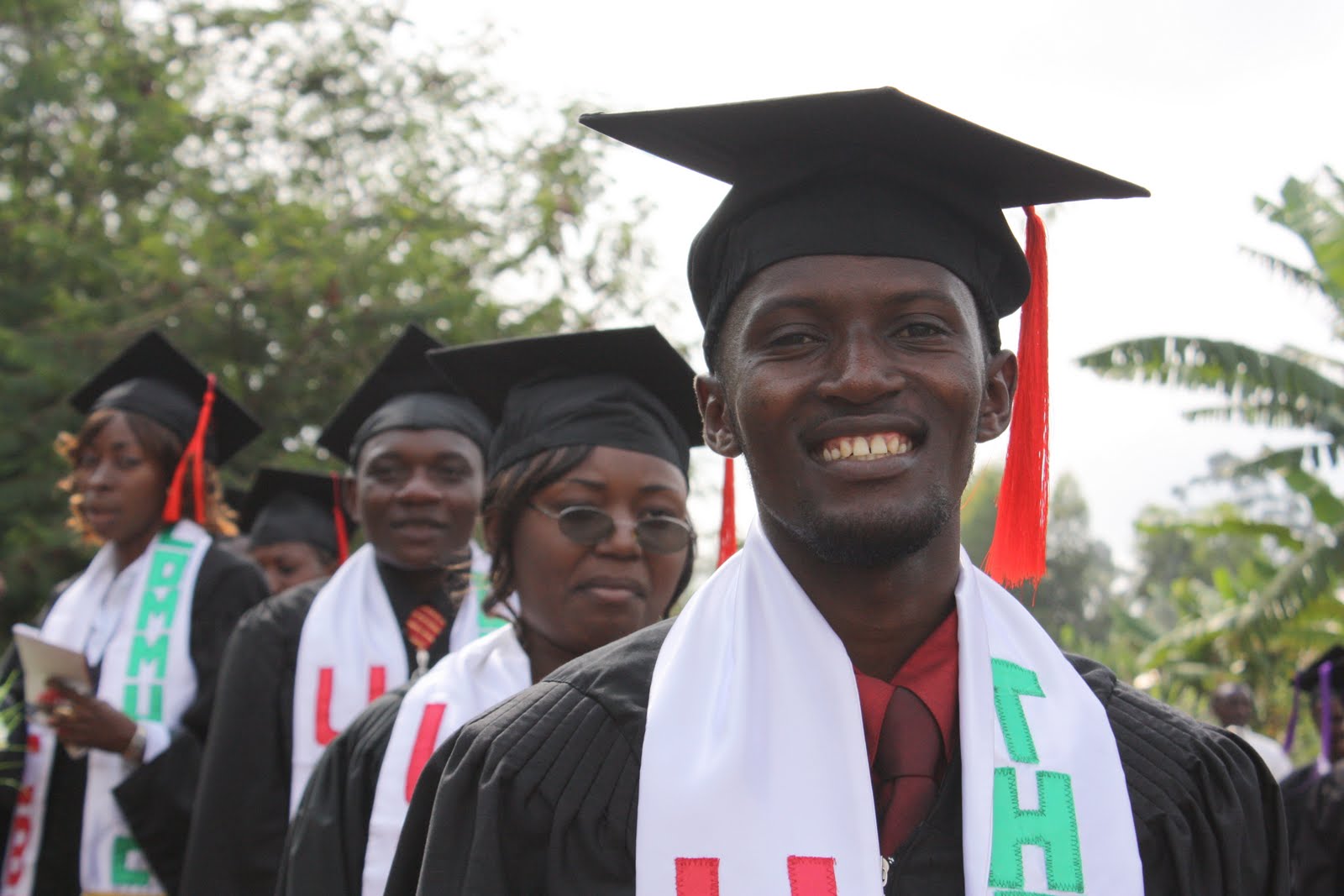
Our first class of students has graduated from UCBC!!

These students came to UCBC for our first year, in 2007. They are our pioneers... Truly, they helped to build and develop UCBC. 

It was a joyous day celebrating with the community, these students' accomplishments. 

Many are going to start work, some will continue their studies at UCBC and others will continue in other universities. 

I'll try to upload more photos soon... :)

All is well here in Beni. It's good to be back and to work with the staff here again. More soon...

with love,
Bethany