Thursday, April 7, 2011

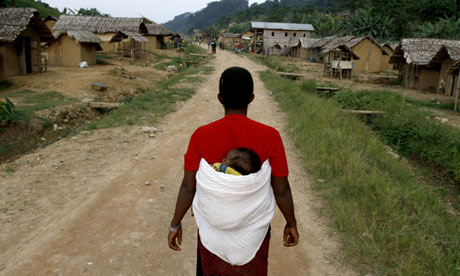
Suffering In The Congo 'Seems To Be Anonymous'

http://minnesota.publicradio.org/features/npr.php?id=135172923


Suffering In The Congo 'Seems To Be Anonymous'

by Alan Greenblatt, National Public Radio
April 6, 2011

During the past 15 years, the Democratic Republic of the Congo has been ravaged by a series of wars that have left more than 5 million people dead and at least 2 million more displaced.

The central African nation has become one of the deadliest killing fields seen since the end of World War II. Yet the series of Congolese conflicts has drawn less attention in the U.S. and Europe than mass slaughters in places such as Darfur and Rwanda that resulted in far fewer deaths.

The wars in Congo have their roots, in fact, in the Rwandan genocide. More than a million Rwandans fled into Congo in the wake of the slayings in 1994 — alongside thousands of killers. The Rwandan army, joined by other outside forces, eventually entered the Congo in pursuit of genocidaires and helped overthrow Mobutu Sese Seko, the Congo's longtime dictator, in 1997.

But Mobutu's successors have not succeeded in setting up an effective central government. In time, the armies of nine nations fought on Congolese soil, both with and against dozens of armed groups within the country, creating a bitter mix of revenge killings, corruption, ethnic hatreds and warlordism.

As the Congo prepares for presidential and parliamentary elections this November, NPR spoke with Jason K. Stearns, an expert on the country who is working on a doctorate in political science at Yale University. Stearns has worked for both the United Nations and local human-rights groups in the Congo.

He has just published Dancing in the Glory of Monsters: The Collapse of the Congo and the Great War of Africa, a lucid and sobering history of the nation's recent conflicts.

Recently, questions have been asked repeatedly about why the U.S. and other powers intervened in Libya but not in other countries convulsed by violence, including the Congo. What are your thoughts about the different responses?


Stearns: Obviously, politics matter a lot, and national interests. But framing matters a lot, too. Libya came on the heels of Egypt and Tunisia. It was part of a more general story and people were made to care. There was a hypothetical massacre that was going to happen in Benghazi. There was a lot of pressure to do something about this.

But there are new statistics that will be coming out soon that over the course of a year in the Congo, 400,000 women were raped. That's not hypothetical; those are statistics in a study carried out by academics with funding from the U.S. government.

When the Congo does pop up on the radar, the suffering seems to be anonymous, with an equally anonymous perpetrator. At the moment, there are over 30 different armed groups active in the Congo, and they're all abusive. And the government is abusive as well.

Do you think that kind of complexity is the reason the Congo receives less attention than places like Libya or Darfur?


It's a conundrum. We care less about things that are more complex. If we can't fit loss of lives into a simple narrative, we care less about them.

If you can point your finger at who has direct responsibility, it's much easier to craft the story and make people care. Whereas if it's a mess and it's difficult to detect the heroes or the villains, it's going to be much more difficult to sell that story if you're a journalist or even a diplomat or aid worker.

Secretary of State Hillary Clinton did address the problem of mass rape in eastern Congo last summer. What has been the impact of that?


Many people in the State Department seem to be genuinely seized by the issue. You've had numerous people out in the field working on different initiatives.

But there were all these different departments involved and that had almost a counterproductive effect, in that lots of people were doing little projects and there was no comprehensive strategy. People in the U.S. government care, but this has not yet translated into a coherent overall strategy, a larger political push that would lead to reform in the Congo.

The Congo will be holding elections this fall — one of an unusual number of elections being held in Africa this year. How do you think the upheaval in the Arab world might affect elections in sub-Saharan Africa and how incumbents will prepare for them?


I'll tell you what will have a serious impact, and that's the Ivory Coast. I talk with African politicians and they're watching the Arab world events, but they're really watching the Ivory Coast.

It's not the first time an African leader has thrown out the results of an election, but this time, not only did the U.N. and the Western states stand firm, but the countries in the region and the African Union stood firm, with concrete sanctions on the regime.

That happened months ago and it sent a shock through the Congolese political situation. Then, on Monday, the U.N. made it clear it would take sides and fire on the [President Laurent] Gbagbo positions. This was unprecedented in Africa.

There has been no reliable polling in the Congo but [President Joseph] Kabila is widely seen as not very popular in the country. The incumbent stands a good chance of losing free and fair elections. That obviously brings with it great risks and there hasn't been enough focus on that.

The Congo is a country that has suffered both from internal strife and interference by outside groups, not to mention its brutal colonial past. But what can other countries do to help it become more stable?


There's no silver bullet. It's a complex problem that has an enormous amount to do with institutional failure. We see in Afghanistan, a country where we have devoted a large amount of capital, the difficulty for foreigners trying to intervene and set up a stable government.

But the U.S. and the foreign community need to invest serious resources into promoting comprehensive reform in the Congo that creates institutions that are not only more professional but accountable — creating a state that is interested in protecting its citizens, rather than preying on them. That's a generational change that is maybe going to come in 20 years, not one.

This requires an enormous amount of political and financial capital. The only way the U.S. is going to get involved is if people in the U.S. see this as a humanitarian or moral issue in which we need to get involved. But it's very difficult to get people to care about complex suffering that's so far away.

Copyright 2011 National Public Radio. To see more, visit http://www.npr.org/.

Thursday, March 3, 2011

Simply Incredible

Check out this amazing slideshow from BBC... Showcasing the beauty, differences and similarities of people all around the world. It's about 7 minutes long - and absolutely worth watching!
love,
Bethany

BBC News:: Audio slideshow: Human Planet

From the icy Arctic to Africa's dense jungles - and the mountain tops of Mongolia to the deep waters of the Pacific - the BBC series Human Planet has explored mankind's incredible relationship with nature.
Accompanying the film crews was photographer Timothy Allen. His stunning still images captured unique glimpses of people living in the world's most extreme environments. Take a look at some of them, and listen to him explain how he snapped the most arresting shots.
A tribesman at the Mount Hagen Sing Song (Western Highlands, Papua New Guinea) - Timothy Allen

Thursday, February 17, 2011

A fast favorite:: One Day

Very powerful words to this song.

One Day - by Matisyahu


Sometimes I lay under the moon and thank God I'm breathing.
Then I pray, "don't take me soon." 'Cause I am here for a reason.

Sometimes in my tears I drown,
But I never let it get me down.
So when negativity surrounds,
I know someday it will all turn around because,

All my live I've been waiting for,
I've been praying for, for the people to say,
That we don't wanna fight no more.
There'll be no more wars, and our children will play.

One day....

It's not about win or lose.
Cause we all lose when they feed on the souls of the innocent,
Blood-drenched pavement
Keep on moving though the waters stay raging

And in this maze you can lose your way
It might drive you crazy but don't let it phase you, no way
No way

Sometimes in my tears I drown,
But I never let it get me down.
So when negativity surrounds, 
I know someday it will all turn around because,

All my live I've been waiting for,
I've been praying for, for the people to say,

That we don't wanna fight no more. 
There'll be no more wars, and our children will play.

One day, one day, one day...

One day this all will change, treat people the same
Stop with the violence, down with the hate.
One day we'll all be free and proud to be 
Under the same sun singing songs of freedom like:

One day, one day, one day...

All my live I've been waiting for,
I've been praying for, for the people to say,
That we don't wanna fight no more. 
There'll be no more wars, and our children will play.

One day, one day, one day...

Wednesday, February 16, 2011

Photos on Picasa

Recent pictures - on my online photo album at Picasa.


Enjoy! :)

with love,
Bethany

Friday, February 4, 2011

Food...


Peanut Butter M&M's
Eating habits gone awry 

Living in Congo for a number of months at a time has always left me with cravings for food that I can't get there. Things that make me miss the States just a bit more...

For example:


Alfredo sauce - for pasta!

REAL cheese... 
From Wisconsin, of course!


Boneless, skinless chicken breasts - so easy to cook!

Warm (or any!) chocolate chip cookies, baked in an oven 
 
Cold water (no ice, please)
  
Thai food... Any kind! 

I scream you scream... 
~~~~~~~~~~~~~~~~~~~~~~~~~~~~~~~~~~
And while here, I also miss some of the food that we have there... Which no matter how hard I try, either cannot be had here in the USA, or it really just doesn't compare to the real thing.

Passion fruit

Until you try a ripe pineapple... You don't know what you're missing!
Nyama choma (roasted meat) - pictured with chapati and cabbage

Chai (tea) - with biscuits! 
~~~~~~~~~~~~~~~~~~~~~~~~~~~~~~~~~~
I've attempted to make Congolese food - such as shu (cabbage), chapati, beans fried plantains, meat... But it just isn't quite the same!
It's a heck of a lot easier to cook on a gas stove! 

Thankfully, I've had the things that I crave while in Congo... a number of times these last few months. And probably more that I can't even think of right now. I actually haven't had too many peanut butter M&M's... But that can always be fixed! :)

~~~~~~~~~~~~~~~~~~~~~~~~~~~~~~~~~~

Some of the cravings for American food (if it can be called that), WHILE being here in the States, as odd as they may be: 
Grapefruit!
Hot dogs!


Sweet carrots

Yum!


And what did I have for lunch today? 
      A "batter wrapped hot dog on a stick."

Yep.
I may need help. 

Monday, January 24, 2011

Blech...

For some reason, my blog, this website is being stupid. It's removed my photo and I cannot get it back in there... As it had been.
Or any photo in there like before.
Now I can only put small photos at the top of this page. Which I don't like.
And I don't know why it's like this!!!
Why can't I edit?!
Stupid blogger... Or maybe me?
haha

Monday, January 17, 2011

Patrice Lumumba

On January 17th, 1961, Patrice Lumumba was killed.

This is an interesting and informative article about him and his country, the DR Congo. Click on the link to read the article.

The Guardian - Patrice Lumumba: the most important assassination of the 20th century 
The US-sponsored plot to kill Patrice Lumumba, the hero of Congolese independence, took place 50 years ago today
patrice lumumba

Article on the Guardian website

Sunday, January 9, 2011

It's the little things...

...Like seeing a mole for the first time, that provide for some genuine entertainment!

The voices you hear in the background are Brandon (the one with the stick), Meredith (she said it was cute), Grant and me. This was in February or March of 2010.

I don't think I'd ever seen one before - it was pretty cute for a rodent!!

Thursday, January 6, 2011

A new year and the violence still continues...


Please remember to keep the Congo in your prayers...


The purpose of UCBC and Congo Initiative is no less important in light of this news... The need is in fact even greater for people to believe they deserve and can attain a better future. 

with hope,
Bethany


Médicins Sans Frontiéres [Doctors Without Borders] says women were restrained with ropes before attack in Fizi, South Kivu, in eastern Congo.  

David Batty
The Guardian, Friday 7 January, 2011


More than 30 women were raped in a coordinated attack in the Democratic Republic of Congo on New Year's Day, the aid agency Médecins Sans Frontières has reported.
MSF said 33 women were raped in Fizi, South Kivu, in the eastern part of the war-torn country.
"Women had been restrained with ropes or beaten unconscious with the butt of a gun before being attacked, some in front of their children," said Annemarie Loof, an official with the medical aid organisation. "Up to four armed men were involved at a time and homes and shops were looted," she said in a statement.
Congo rapes
MSF teams treated 14 women at the hospital in Fizi on 3 January, and 19 the next day. Two severely wounded people were transferred to Baraka hospital, one with serious head injuries after being beaten with a rock, the other having been shot in the chest.
The United Nations says rape is a frequent weapon of war in Congo. Around 15,000 women were raped in eastern Congo in 2009. It is believed that many cases go unreported.
In September, a UN report condemned Congo's security forces for failing prevent a mass rape last summer.
It confirmed the rape of at least 240 people between 30 July and 4 August in the Walikale region of Congo's North Kivu province by Rwandan and Congolese rebels in a brazen attack near a UN peacekeepers' base.
The reported victims in previous attacks ranged from a month-old baby boy to a 110-year-old woman.
Survivors have accused the FDLR rebel group – which is led by perpetrators of the Rwandan genocide who fled to Congo – along with Congolese Mai-Mai militia.
Between 200 and 400 rebels systematically raped and looted in the town of Luvungi and five nearby villages, according to the International Medical Corps.
It said husbands were forced to watch their wives being raped, while others were dragged into a nearby forest.
The attacks occurred in parts of the country where armed rebel groups moved into areas considered to be pro-government but lacking in army or police protection.
Médecins Sans Frontières said there was no sign that the security situation was improving.
"MSF is extremely concerned about the current situation in and around Fizi," Loof said yesterday. "People are fleeing the area fearing further violent attacks."
The agency provided medical and psycho-social care for 5,600 rape victims in North and South Kivu in 2009.

Monday, January 3, 2011

Thank you from Congo Initiative


Haeder


Bora

Gershon

Donate Now

Dear friends, partners and supporters,

2010 has been a tremendous year of growth and exciting developments for Congo Initiative and the Christian Bilingual University of Congo.  With your encouragement, prayers, friendship, support and steadfast commitment to this work, we are moving forward in faith.  We are seeing the fruits of the investment that we are making together with you, as a new story of hope is being written in and for the heart of Africa.


THANK YOU for being a part of this exciting work!  Thank you for standing with us, for sharing the story of CI-UCBC with your family, friends and colleagues.  Thank you for the support so many of you have given in so many different ways during this past year.  

As we observe the end of 2010 and anticipate a new chapter in 2011, may your lives and those of our team and students in Congo be mutually enriched and blessed.  

Partnering together,

The Congo Initiative Team