It is not the magnitude of our actions but the amount of love that is put into them that matters. - Mother Teresa
Showing posts with label women. Show all posts
Thursday, March 8, 2012
International Women's Day 2012
Happy International Women's Day!
For a history of International Women's Day, click on this link.
And my thoughts on the day, from 2009, can be read by clicking on this link!
with love,
Bethany
Labels:
celebration,
Congo Initiative,
DR Congo,
International Women's Day,
UCBC,
women
Wednesday, October 12, 2011
Silence is "not" golden...
This is an interesting opinion piece on Huffington Post
http://www.huffingtonpost.com/rev-otis-moss-iii/congo-breaking-the-silenc_b_1003431.html
I love when I find articles about Congo... Most aren't good or positive, but hearing and knowing people are talking (even if just a little) about this country, is so important!
http://www.huffingtonpost.com/rev-otis-moss-iii/congo-breaking-the-silenc_b_1003431.html
I love when I find articles about Congo... Most aren't good or positive, but hearing and knowing people are talking (even if just a little) about this country, is so important!
Silence Is 'Not' Golden When It Comes To The Congo
Rev. Otis Moss III
Senior Pastor, Trinity United Church of Christ in Chicago
The ancient proverbial statement says, "Silence is golden." But how can a person, especially a person of faith, be silent when a woman is raped every minute and 45,000 children, women and men are dying in the Democratic Republic of Congo?
The Democratic Republic of Congo is the one of the most mineral-rich countries in the world. 64 percent of the world's reserve of Coltan, the mineral that allows you to read this on your iPad, laptop, desktop computer or cell phone -- comes from the Democratic Republic of Congo. The commercial sale of cell phones and computers is a $1 billion dollar per year global industry. But 80 percent of Congolese women, men and children live on 30 cents or less per day. At the July 2011 "Voices from the Congo" Conference at the U.S. Holocaust Memorial Museum, U.S. Senator Dick Durbin (D-IL) , who has traveled to the Congo twice said, "It is a nation of breathtaking natural beauty, rich in natural resources. It is also a badly broken country dominated by relentless poverty, war lords, pillaging soldiers, and horrific, almost incomprehensible violence."
The national and global politics of Blood Coltan mining includes the minute-by-minute rape of women and the deaths of children every day. The six million deaths caused by Blood Coltan mining exceeds the number of people who have died around the world in any war in the history of humanity. Why is the world silent? Why is the Christian community silent? Why is the interfaith community silent about this indescribable human tragedy?
Like the Bible, each religion's source of truth emphasizes that love, righteousness and justice are guiding principles for human beings. Yet, silence is offered instead of an interfaith clarion call for justice on behalf of our beloved Congolese sisters and brothers. Are we not our brothers' and sisters' keepers?
We must break the silence about the daily child deaths, rape of women and economic and human exploitation that is occurring in the Democratic Republic of Congo and around the world.
Trinity United Church of Christ and the rest of the global "Breaking the Silence" community will participate in the Blood Coltan "Cell Out" Awareness Campaign, October 16 -22. While the challenges seem overwhelming, we can stop the maiming, rape and exploitation of children, families and communities. It's critical that even after this campaign we continue to nonviolently protest the Blood Coltan mining tragedy. By not using your cell phone every Wednesday from noon until 1:00 p.m. and from 7:00 p.m. until 8:00 p.m. you can show your solidarity with those being exploited. I also encourage you to email and call members of Congress with a clear moral message: stop the exploitation, and protect the people of the Congo.
Silence is not golden when 45,000 people die every month and innocent youth are forced to be child soldiers. How can we as a nation and a faith community ignore these horrific injustices? Silence to wrongful death is not golden. Silence to exploitation of the poor is not golden. It is time to "Break the Silence." The sins of racism and oppression in the Congo and around the world must stop.
The Democratic Republic of Congo is the one of the most mineral-rich countries in the world. 64 percent of the world's reserve of Coltan, the mineral that allows you to read this on your iPad, laptop, desktop computer or cell phone -- comes from the Democratic Republic of Congo. The commercial sale of cell phones and computers is a $1 billion dollar per year global industry. But 80 percent of Congolese women, men and children live on 30 cents or less per day. At the July 2011 "Voices from the Congo" Conference at the U.S. Holocaust Memorial Museum, U.S. Senator Dick Durbin (D-IL) , who has traveled to the Congo twice said, "It is a nation of breathtaking natural beauty, rich in natural resources. It is also a badly broken country dominated by relentless poverty, war lords, pillaging soldiers, and horrific, almost incomprehensible violence."
The national and global politics of Blood Coltan mining includes the minute-by-minute rape of women and the deaths of children every day. The six million deaths caused by Blood Coltan mining exceeds the number of people who have died around the world in any war in the history of humanity. Why is the world silent? Why is the Christian community silent? Why is the interfaith community silent about this indescribable human tragedy?
Like the Bible, each religion's source of truth emphasizes that love, righteousness and justice are guiding principles for human beings. Yet, silence is offered instead of an interfaith clarion call for justice on behalf of our beloved Congolese sisters and brothers. Are we not our brothers' and sisters' keepers?
We must break the silence about the daily child deaths, rape of women and economic and human exploitation that is occurring in the Democratic Republic of Congo and around the world.
Trinity United Church of Christ and the rest of the global "Breaking the Silence" community will participate in the Blood Coltan "Cell Out" Awareness Campaign, October 16 -22. While the challenges seem overwhelming, we can stop the maiming, rape and exploitation of children, families and communities. It's critical that even after this campaign we continue to nonviolently protest the Blood Coltan mining tragedy. By not using your cell phone every Wednesday from noon until 1:00 p.m. and from 7:00 p.m. until 8:00 p.m. you can show your solidarity with those being exploited. I also encourage you to email and call members of Congress with a clear moral message: stop the exploitation, and protect the people of the Congo.
Silence is not golden when 45,000 people die every month and innocent youth are forced to be child soldiers. How can we as a nation and a faith community ignore these horrific injustices? Silence to wrongful death is not golden. Silence to exploitation of the poor is not golden. It is time to "Break the Silence." The sins of racism and oppression in the Congo and around the world must stop.
Labels:
children,
conflict minerals,
DR Congo,
eastern Congo,
life,
mining,
peace,
violence,
women
Saturday, May 21, 2011
Women in danger in the Congo - CNN
A new study finds startling numbers of women are victims of rape in the Democratic Republic of Congo.
But published after this story and the study that they reference, was an article by BBC News:
A new study on rape in the Democratic Republic of Congo is based on out-of-date and questionable figures, a Swedish academic has told the BBC.
It concluded that 48 women and girls are raped every hour in DR Congo.
But Maria Eriksson Baaz says it is difficult to collect reliable data in DR Congo and women sometimes claim to be victims to get free health care.
She also questioned the links made between rising rape elsewhere in DR Congo and the conflict in the east.
Sexual violence has long been a dominant feature of the continuing unrest there.
The rape study was published last week in the American Journal of Public Health and found that 400,000 females aged 15-49 were raped over a 12-month period in 2006 and 2007.
[...]
The entire BBC News article can be found at: http://www.bbc.co.uk/news/world-africa-13448513
So what is the truth?
Are there women who are being taken advantage of by men in their country? - Yes
Is rape a problem in the DR Congo? - Yes
Change.
It's not just about raising awareness of something terrible that happens too often to too many women, young and old. It's about gaining the tools necessary to combat ignorance, intolerance, hatred and bitterness, and to attain reconciliation. It's about not getting to the point where one joins the endless cycle of abuse that Congo seems trapped into repeating. Learning how to handle situations differently in the future.
The question remains, what do we do now? That is something that our students wrestle with as well.
UCBC offers quality professors, teachers, leadership, vision and education to men and women in eastern DR Congo. Maybe together with students, teachers and community leaders, we can challenge and change the system that is destroying the future of Congo's people.
Thursday, January 6, 2011
A new year and the violence still continues...
Please remember to keep the Congo in your prayers...
The purpose of UCBC and Congo Initiative is no less important in light of this news... The need is in fact even greater for people to believe they deserve and can attain a better future.
with hope,
Bethany
Médicins Sans Frontiéres [Doctors Without Borders] says women were restrained with ropes before attack in Fizi, South Kivu, in eastern Congo.
David Batty
The Guardian, Friday 7 January, 2011More than 30 women were raped in a coordinated attack in the Democratic Republic of Congo on New Year's Day, the aid agency Médecins Sans Frontières has reported.
MSF said 33 women were raped in Fizi, South Kivu, in the eastern part of the war-torn country.
"Women had been restrained with ropes or beaten unconscious with the butt of a gun before being attacked, some in front of their children," said Annemarie Loof, an official with the medical aid organisation. "Up to four armed men were involved at a time and homes and shops were looted," she said in a statement.
MSF teams treated 14 women at the hospital in Fizi on 3 January, and 19 the next day. Two severely wounded people were transferred to Baraka hospital, one with serious head injuries after being beaten with a rock, the other having been shot in the chest.
The United Nations says rape is a frequent weapon of war in Congo. Around 15,000 women were raped in eastern Congo in 2009. It is believed that many cases go unreported.
In September, a UN report condemned Congo's security forces for failing prevent a mass rape last summer.
It confirmed the rape of at least 240 people between 30 July and 4 August in the Walikale region of Congo's North Kivu province by Rwandan and Congolese rebels in a brazen attack near a UN peacekeepers' base.
The reported victims in previous attacks ranged from a month-old baby boy to a 110-year-old woman.
Survivors have accused the FDLR rebel group – which is led by perpetrators of the Rwandan genocide who fled to Congo – along with Congolese Mai-Mai militia.
Between 200 and 400 rebels systematically raped and looted in the town of Luvungi and five nearby villages, according to the International Medical Corps.
It said husbands were forced to watch their wives being raped, while others were dragged into a nearby forest.
The attacks occurred in parts of the country where armed rebel groups moved into areas considered to be pro-government but lacking in army or police protection.
Médecins Sans Frontières said there was no sign that the security situation was improving.
"MSF is extremely concerned about the current situation in and around Fizi," Loof said yesterday. "People are fleeing the area fearing further violent attacks."
The agency provided medical and psycho-social care for 5,600 rape victims in North and South Kivu in 2009.
Thursday, December 9, 2010
"Opportunities to Lead"
The following is written by Congo Initiative board member, Mary Henton. Please read and reflect... What are we being called to do? In our own lives, in the lives of others? It's a question that I think I need to ask myself more often... And listen to the answer(s) that I am given!
This is a beautifully written piece and I hope you will enjoy it.
-Bethany
A recent weekend trip to the town of Epulu (about 250 miles northwest of Beni) provided an opportunity to observe, reflect, and listen. What I observed, reflected upon, and heard in my heart were two persistent themes: (1) UCBC can take a lead in environmental education; and (2) UCBC has a responsibility to take action on behalf of women.
The scenery along the road to Epulu was magnificent: lush vegetation, surging rivers (Ituri and Epulu), glorious skies. But I was troubled to see evidence of the race to extract Congo's natural resources: old growth timber toppled, workers loading trucks with timber, plots of forest burned and tattered. Our hosts in Epulu spoke about the decimation of wildlife from poaching and loss of habitat. Here in Beni we see the pollution of waterways. But in the midst of this destruction UCBC has an opportunity. It is an opportunity to educate, to raise up professionals and practitioners, to develop and demonstrate a new ethic of resource stewardship, and create new models of sustainable resource management.
UCBC has an opportunity to transform how communities see and use their natural resources by cultivating a creation care ethic. We can make wise choices about our own land and natural resource use. We can also educate our students about the ethics of resource stewardship. And what an impact we could make if we established a faculty in environmental studies and/or sustainable resource management!
A second theme - As we passed Congo's women carrying loads of firewood, charcoal, water, and crops, I was reminded of the evidence regarding the significant role that women play in developing their local and national communities. A growing body of literature, including the recent publication, Half the Sky (WuDann and Kristoff), confirms that as the education, health, and opportunities for women improve in developing communities, so do the health, education, and opportunities for the entire community. As we passed women along the road, I thought, "We must, at UCBC, develop our women students and nurture strong women leaders. If we are going to transform this nation, we must make an intentional commitment to women's development." But what does/would that look like?
To begin with, we can be proud of our track record in highlighting women and gender issues such as our annual celebration of Women's Day and last year's gathering of women lawyers. We can also be proud of the ratio* of female/male students at UCBC.
However, we also have the challenge of bringing into similar balance the ratio of female/male faculty and administrators-Congolese or African faculty and administrators. We must give our students models of women in leadership, academics, and research. We must give them opportunities to learn from the voices, perspectives, and styles of women as well as of men.
We will keep listening for how our priorities and plans might coalesce around the deep needs and promises of this magnificent country that is Congo.
- Mary Henton
Mary is a Congo Initiative Board member and has spent the past two months living in Beni working on a variety of projects with our Congolese team. She is a life-long educator with expertise in teacher education, curriculum development, experiential learning and non-profit management.
Labels:
Congo Initiative,
DR Congo,
education,
Great Lakes region,
hope,
opportunity,
resources,
transformation,
UCBC,
women
Friday, September 3, 2010
Am I doing all that I that I can?
Rape Victims in Congo Raid Now More Than 240 - NY Times
Excerpts from this article are below. The full story can be read here: http://www.nytimes.com/2010/09/03/world/africa/03congo.html?ref=africa
The number of rape victims from a four-day rebel attack in eastern Congo a month ago has risen to more than 240 and will likely go higher, aid officials said Thursday.
[...]
On July 30, hundreds of members of Rwandan and Congolese rebel groups occupied villages in the Walikale region of North Kivu, assaulting their victims in groups of two to six.
Countering reports from the area that some victims were male infants, Mr. Trombatore said that all were female and that the youngest was 16 years old and the oldest 75.
[...]
Since the United Nations first publicly reported the mass rapes on Aug. 22, questions have arisen over how much the United Nations knew about the attacks as they were under way.
United Nations officials have said the peacekeepers did not know about the rapes until Aug. 12.
But a leaked United Nations e-mail dated July 30 shows that officials there were aware that the rebels had taken over one of the villages and raped one woman within the first day of the attack. By Aug. 10, the United Nations was aware that at least 25 women had been raped, according to another United Nations bulletin, published online.
They knew. And yet they still didn't act. They knew one woman had been harmed and villages taken over. But they told others to stay away. And they didn't try to stop it or to help.
How often do we, do I, act in a similar way, with other things? Knowing someone is in need, seeing them in their pain, their struggle... Yet there I am, frozen. Unwilling or unsympathetic to move. Afraid of what I might find or might I might have to give up, in order to help someone else.
Ah Lord, that my heart would break for the things that break yours. And that I would act in response to the brokenness that I see and that I know about. Even if it's in a small way, but the best I can manage. I should not remain silent. I must act.
Excerpts from this article are below. The full story can be read here: http://www.nytimes.com/2010/09/03/world/africa/03congo.html?ref=africa
The number of rape victims from a four-day rebel attack in eastern Congo a month ago has risen to more than 240 and will likely go higher, aid officials said Thursday.
[...]
On July 30, hundreds of members of Rwandan and Congolese rebel groups occupied villages in the Walikale region of North Kivu, assaulting their victims in groups of two to six.
Countering reports from the area that some victims were male infants, Mr. Trombatore said that all were female and that the youngest was 16 years old and the oldest 75.
[...]
Since the United Nations first publicly reported the mass rapes on Aug. 22, questions have arisen over how much the United Nations knew about the attacks as they were under way.
United Nations officials have said the peacekeepers did not know about the rapes until Aug. 12.
But a leaked United Nations e-mail dated July 30 shows that officials there were aware that the rebels had taken over one of the villages and raped one woman within the first day of the attack. By Aug. 10, the United Nations was aware that at least 25 women had been raped, according to another United Nations bulletin, published online.
They knew. And yet they still didn't act. They knew one woman had been harmed and villages taken over. But they told others to stay away. And they didn't try to stop it or to help.
How often do we, do I, act in a similar way, with other things? Knowing someone is in need, seeing them in their pain, their struggle... Yet there I am, frozen. Unwilling or unsympathetic to move. Afraid of what I might find or might I might have to give up, in order to help someone else.
Ah Lord, that my heart would break for the things that break yours. And that I would act in response to the brokenness that I see and that I know about. Even if it's in a small way, but the best I can manage. I should not remain silent. I must act.
Thursday, August 26, 2010
Reason to celebrate
Some of the women of Eastern DR Congo... Beautiful, joyful, loving... This is why we need to fight for their protection and the future of the country! Can we get justice in this country, please?
This was the day when I met everyone (for the first time) in this short video. I'd also never heard that song before! We were celebrating one young mother's baptism:
Wednesday, August 25, 2010
At Least 150 Women Raped in Weekend Raid in Congo - NY Times
Oh God... What do we do?
The women of North Kivu... My sisters, mothers, students, daughters...
At Least 150 Women Raped in Weekend Raid in Congo - NY Times
By JOSH KRON
Published: August 22, 2010
GOMA, Democratic Republic of Congo — A mob of Rwandan rebels gang-raped at least 150 women last month during a weekend raid on a community of villages in eastern Congo, United Nations and other humanitarian officials said Sunday.
The United Nations blamed the Democratic Forces for the Liberation of Rwanda, or F.D.L.R., for the attack. The F.D.L.R. is an ethnic Hutu rebel group that has been terrorizing the hills of eastern Congo for years, preying on villages in a quest for the natural resources beneath them.
The raided villages are near the mining center of Walikale, known to be a rebel stronghold, and are “very insecure,” said Stefania Trassari, a spokeswoman for the United Nations Office for the Coordination of Humanitarian Affairs. “Rape is something we get quite often.”
But she and other United Nations and humanitarian officials said that this attack was unusual because of the large number of victims and the fact that they were raped by more than one attacker simultaneously.
On the evening of July 30, armed men entered the village of Ruvungi, in North Kivu Province.
“They told the population that they were just there for food and rest and that they shouldn’t worry,” said Will F. Cragin, the International Medical Corps’ program coordinator for North Kivu, who visited the village a week after their arrival.
“Then after dark another group came,” said Mr. Cragin, referring to between 200 and 400 armed men who witnesses described as spending days and nights looting Ruvungi and nearby villages.
“They began to systematically rape the population,” he said, adding, “Most women were raped by two to six men at a time.”
The attackers often took the victims into the bush or into their homes, raping them “in front of their children and their families,” Mr. Cragin said. “If a car passed, they would hide.”
The rebels left on Aug. 3, he said, the same day the chief of the area traveled through the villages and reported horrific cases of sexual violence. “We thought at first he was exaggerating,” Mr. Cragin said, “but then we saw the scale of the attacks.”
Miel Hendrickson, a regional director for the International Medical Corps, which has been documenting the rape cases, said, “We had heard first 24 rapes, then 56, then 78, then 96, then 156.”
“The numbers keep rising,” she said. The United Nations maintains a military base approximately 20 miles from the villages, but United Nations officials said they did not know if the peacekeepers there were aware of the attack as it occurred. A United Nations military spokesman, Madnoje Mounoubai, said information was still being gathered.
The F.D.L.R., which began as a gathering of fugitives of the Rwandan genocide in 1994, has grown into a resilient and savage killing machine and an economic engine in the region.
The United Nations, Congo and Rwanda began a military offensive against the group in early 2009, but since then, humanitarian organizations say, cases of rape have risen drastically.
“It’s awful,” Ms. Trassari said. “The numbers are quite worrying.”
Secretary of State Hillary Rodham Clinton visited eastern Congo in 2009 to raise awareness about widespread rape in the region, calling it “evil in its basest form,” and the United States pledged $17 million to the Congolese government to fight sexual violence.
A version of this article appeared in print on August 23, 2010, on page A8 of the New York edition.
Friday, August 13, 2010
Action Jackson: Running the World's Most Dangerous Marathon - www.tonic.com
Running for the Congo... In the Congo...http://www.tonic.com/article/action-jackson-running-the-worlds-most-dangerous-marathon-chris-jackson/
This is a neat article about what one man is doing to try to raise public awareness of what is happening in the DR Congo.
Wednesday, August 11, 2010
What Are You Carrying? - NY Times
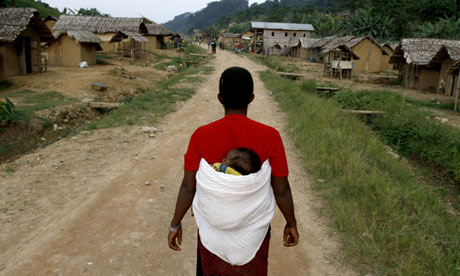
A glimpse at what Congolese women carry.
(First seen on Michelle and Aaron's blog. Thanks!)
Subscribe to:
Posts (Atom)